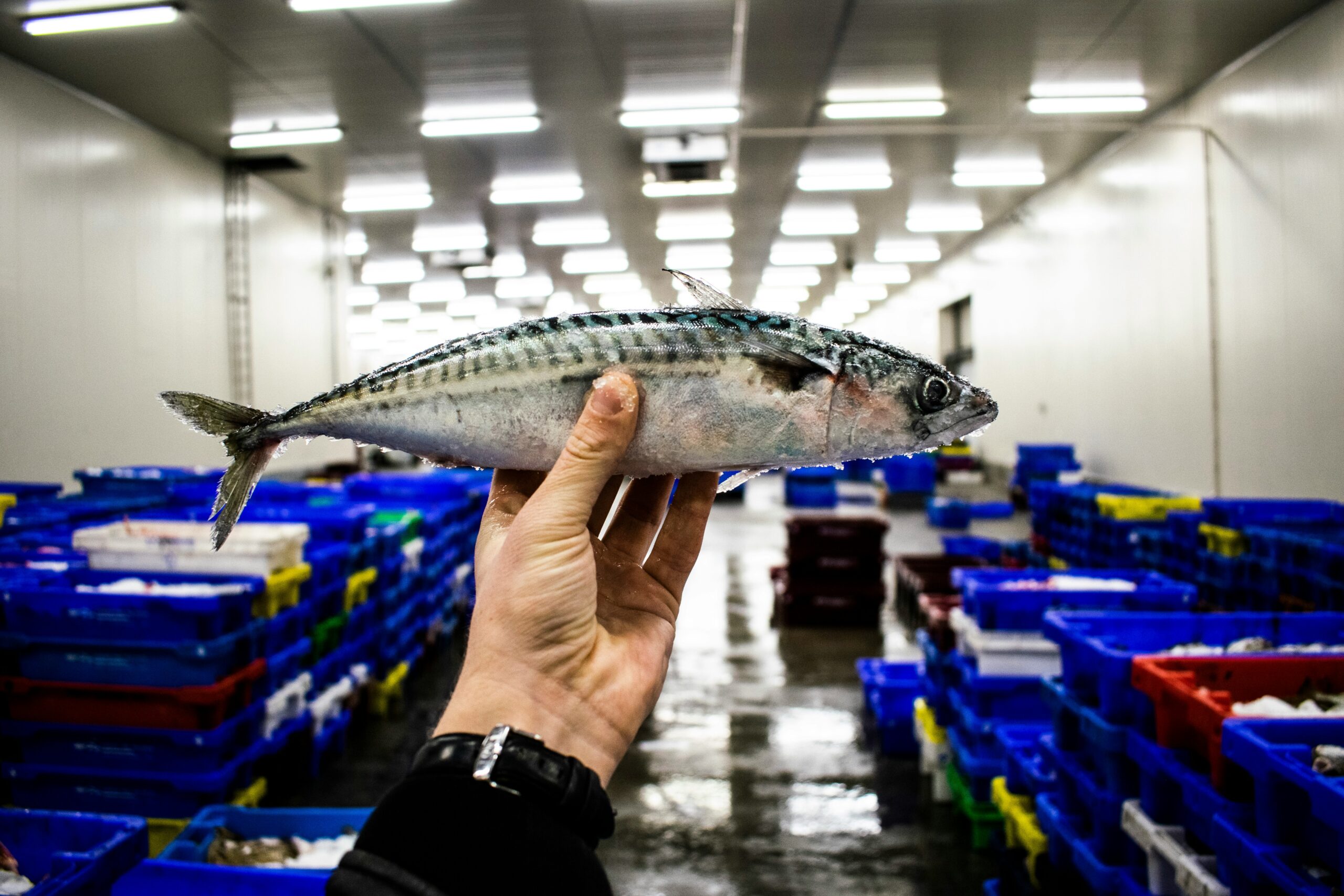
Photo by Paul Einerhand
ICES has advised that catches of Northeast Atlantic mackerel in 2027 should be no more than 352,938 tonnes. That is more than double its advice of 174,357 tonnes for 2026, but still around 11% below the 398,186 tonnes ICES forecasts will actually be caught this year. ICES notes that there is no internationally agreed total allowable catch (TAC) for 2026.
The increase reflects improved recruitment from the 2024 year class, along with higher average fish weights, which have lifted spawning stock biomass back above Blim, the limit below which a stock’s capacity to reproduce is considered impaired. Even so, under the advised catch ICES puts the probability of the stock falling below Blim in 2028 at 33.2%. Under a zero-catch scenario that probability would still be 16.9%.
Industry welcomes the turnaround
The UK catching and processing sector welcomed the advice. Ian Gatt, chair of the Scottish Pelagic Sustainability Group, said: “We welcome this news, although there is still a way to go to ensure the mackerel stock builds back to the biomass level associated with achieving Maximum Sustainable Yield (MSY). This includes the need to reach a quota shares agreement with all coastal states involved in the fishery.”
In December 2025 the UK, Norway, the Faroe Islands and Iceland agreed a combined 2026 catch limit of 299,010 tonnes, more than 100,000 tonnes above ICES advice but around 60% lower than the previous year’s limits. Gatt argued that the latest figures support that approach. “We believe the current improving stock situation vindicates the decision-making process by coastal states participating in the fishery when they set the 2026 TAC, where socio-economic factors necessary to protect fishing communities and supply chains were also considered alongside the scientific advice,” he said. He also called on the EU and Greenland to join a comprehensive agreement.
A warning against complacency
Conservation groups took a more cautious view. Jonny Hughes, fisheries policy lead at the Blue Marine Foundation, said: “The stock has declined by 72% since 2016 and is still below the level required by international treaties and UK domestic law.” He continued: “The fact the stock has avoided a further decline is good, but it highlights the uncomfortable reality that governments came dangerously close to repeating the mistakes that have driven other fish stocks into collapse.”
Hugo Tagholm, executive director of Oceana UK, acknowledged that the four-party arrangement had helped. “It is good to see that this effort to create a shared agreement allowed mackerel populations to show some signs of recovery,” he said. “But this is a testament to the power of the ocean to persist and recover, it is not a gold star for fisheries management.” Since 2010, combined quotas for the stock have exceeded scientific advice by an average of 39%.
Pressure from the supply chain
The North Atlantic Pelagic Advocacy Group (NAPA), a coalition of retailers, suppliers and food service companies, cautiously welcomed the improvement: “While improvements in stock recovery are welcome news, care is needed as the stock is still in a precarious position – only 4.5 percent above the limit where the risk of stock collapse increases.” NAPA is urging all seven coastal states, namely Norway, Iceland, the Faroe Islands, Greenland, the UK, the EU and Russia, to reach a comprehensive sharing agreement.
The commercial stakes are already visible. Waitrose suspended sourcing and sales of Northeast Atlantic mackerel earlier this year over continued overfishing. The stock lost its Marine Stewardship Council certification in 2019 and has not regained it.
Attention now turns to the coastal states’ negotiations on 2027 catch limits. “As coastal nations begin negotiations this autumn to set 2027 catch limits, they must follow the science and build the recovery,” Tagholm added.